


Our latest newsletter with updates on all of the countries we work in is available here.
We got this news from Kazakhstan this morning and wanted to share with you!
The new law on Marriage and Family was finally approved by Parliament (Mazhilis). The Next step will be approval of the law by Senate. Very good news and means for us that Kaz is one step close to starting the Hague Accreditation process.
The new law on Marriage and Family was finally approved by Parliament (Mazhilis). The Next step will be approval of the law by Senate. Very good news and means for us that Kaz is one step close to starting the Hague Accreditation process.
Update on adoption case processing by MOWCYA in Ethiopia
The U.S. Embassy in Ethiopia has received information from the Ministry of Women, Children and Youth Affairs indicating that processing of cases that received a court summons prior to March 8, 2011 is still ongoing. This exceeds their estimated 15-20 days to expeditiously process this caseload, as indicated in our April 5 notice. The Embassy also understands that processing of cases with court summons after March 8 is proceeding at 5 cases per day, and there is no indication that these numbers will increase in the short term.
Prospective Adoptive Parents and parents awaiting final approval of their match from the Ministry of Women, Children and Youth Affairs are cautioned to anticipate continued and considerable delays and are encouraged to remain in contact with their agency for updates to their case.
Please continue to monitor http://adoption.state.gov/ for updated information as it becomes available.
Prospective Adoptive Parents and parents awaiting final approval of their match from the Ministry of Women, Children and Youth Affairs are cautioned to anticipate continued and considerable delays and are encouraged to remain in contact with their agency for updates to their case.
Please continue to monitor http://adoption.state.gov/ for updated information as it becomes available.
By Farangis Najibullah, Gulaiym Ashakeev
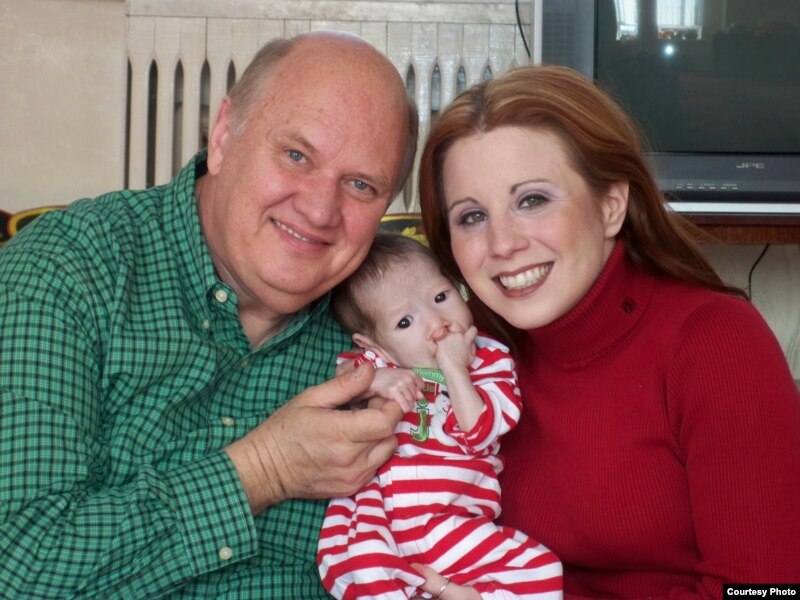 |
| U.S. citizens Frank and Gabrielle Shimkus with their prospective Kyrgyz adoptee Azamat |
May 07, 2011
Azamat was abandoned by his mother at a Bishkek maternity ward the day he was born with a severe cleft lip and palate three years ago.
He has since been living in an orphanage in the Kyrgyz capital and, unlike other children of his age, Azamat cannot speak properly, and has difficulty feeding because of his medical condition.
There has always been hope for Azamat. Gabrielle and Frank Shimkus, potential adoptive parents from the United States, were eager to welcome the Kyrgyz toddler into their home. But there has also been despair, courtesy of a moratorium on international adoptions imposed by the Kyrgyz government in February 2009.
Gabrielle and Frank have been awaiting the day when Kyrgyzstan would amend its Family Code, paving the way for international adoption to resume. That day came on May 6, when Kyrgyz President Roza Otunbaeva signed into law a bill unanimously approved by parliament last month.
The new law opens the door for prospective foreign parents to adopt Kyrgyz children, but it also stipulates strict controls for the adoption process to ensure that children do not fall victim to trafficking, exploitation, or abuse.
The moratorium was imposed amid concerns that the Family Code insufficiently dealt with specifics regarding the oversight of the adoption process. This had led to widespread criticisms that loopholes in the law could put Kyrgyz children at risk once they were outside the country.
In addition, the lack of supervision was seen as a gateway for adoption agencies, officials, and others to take advantage of the situation by giving children away for adoption without proper background checks on adoptive parents. There were also allegations of corruption on the part of officials who would speed up adoption processes in return for bribes.
Strict Control Of Adoption
Kyrgyz lawmaker Damira Niyazalieva says "we needed to put a specific, state body in charge of international adoption, to control the whole process from the very beginning."
According to the amended version of the Family Code, Kyrgyzstan's Social Welfare Ministry will now oversee all adoption cases. This, Niyazalieva says, ensures strict government control.
"For instance, in the past, random adoption agencies would go inside orphanages to pick a child for adoption,” Niyazalieva says. “They would take photos of children to send to the U.S. It's against the law -- now the law bans such activities. No one from outside will have access to orphanages.”
“There will be a so-called bank with the list of all children available for adoption. Only the Social Welfare Ministry will decide which child can be placed for adoption and to which family."
Niyazalieva and other lawmakers have also proposed that Kyrgyzstan sign the Hague Adoption Convention, which strengthens protection for adoptive children. Ratified by 83 countries, the treaty provides a framework for signatory states to work together to ensure that adoptions take place in the best interests of a child.
The draft of the new Kyrgyz Family Code was reportedly prepared a year ago but the 2010 political upheaval in the country delayed its endorsement.
“Kyrgyz 65”
Kyrgyzstan's decision to lift its adoption moratorium has been eagerly awaited by a group known as "Kyrgyz 65." The group was set up by 65 prospective adoptive families from the United States, who began an adoption procedure in Kyrgyzstan two to three years ago, before the process was halted by Kyrgyz authorities.
Gabrielle Shimkus is among the Kyrgyz 65 who have undergone thorough background checks and provided all the necessary documents, including confirmation of their health and financial situation, which are required of potential adoptive families.
Shimkus says she first visited Azamat in November 2008 when he was a frail five-month-old baby referred for adoption by the Kyrgyz authorities.
After spending two weeks with Azamat in Bishkek, the Shimkus family was told to return to Kyrgyzstan after one month to get the final court decision and take Azamat home as their legally adopted child.
Gabrielle Shimkus says the family was weeks away from bringing home a son, but it didn't happen.
Sixty-four other prospective parents were left in a similar situation. They have since involved the U.S. State Department and have contacted a number of U.S. lawmakers in their bid to convince the Kyrgyz authorities to allow adoptions. The group also appealed to Kyrgyz President Otunbaeva.
"We've organized efforts to talk to people in the Kyrgyz government, and we've organized efforts to talk to our own government,” Shimkus says. “And we have conference calls all the time just trying to do everything possible to get our kids home with us.”
“Unfortunately, a lot of the kids have severe medical problems that are treatable and fixable here in the United States. Two of the children of the Kyrgyz 65 passed away and that is such a tragedy in our minds because had the adoptions been able to get through in a timely manner those deaths were preventable."
Some 11,000 orphans and children abandoned by families reside in Kyrgyzstan's 120 orphanages and children's homes. Most of the abandoned babies were born with birth defects or severe disabilities.
"Of the 65 children set to be adopted by American parents, 36 are in urgent need of complicated surgical procedures," the office of Kyrgyz ombudsman told Kyrgyz media. "Their physical conditions are getting worse by every passing day."
Between 2006 and February 2009 -- before the moratorium was put in place -- 235 Kyrgyz children were adopted by families from the United States, Israel, Italy, Germany, and Australia.
The new Family Code gives priority to Kyrgyz families in all adoption cases. But Niyazalieva says adoptive parents in Kyrgyzstan almost never choose a disabled or sick child, while it is not an issue for foreigners, including the Kyrgyz 65.
Cash-Strapped Orphanages
Niyazalieva and the office of the ombudsman are among those who support the idea of reinstating international adoptions, saying it would ensure a much better future for many disabled children who live in underfunded orphanages run by underpaid staff.
Most children's homes in Kyrgyzstan largely depend on cash-strapped state funds and donations by international charity organizations. Conditions are especially dire in state-run orphanages in rural areas, where employees complain about a lack of running water and sewerage systems in children's homes, and a shortage of proper clothes and shoes for kids.
Dr. Gulzhan Ashimova works at a Bishkek care home, which houses 94 sick and disabled children under the age of four.
They need medical attention, including surgeries, speech therapy, and psychological treatments, the doctor says.
"We help them as much as we can, but the orphanage doesn't have enough money for all the treatment we require," Ashimova says. "Some of the required treatments are simply not available in Kyrgyzstan."
Ashimova says that children in orphanages are usually much less developed both physically and psychologically than those who live with families. "The best therapy for them is to live with families," the doctor adds.
While waiting for the Kyrgyz authorities' decision to lift the moratorium, the Shimkus family paid for a German surgeon to begin treatment of Azamat's cleft lip and palate. The doctor visited Bishkek and performed initial medical surgery on Azamat's lip. The toddler needs several more such operations to fully heal his condition.
The family hopes they will be able to continue with the medical treatment in the United States.
"We have already prepared a bedroom full of toys for Azamat in our home, and we all are waiting for our son to finally join us," Gabrielle Shimkus says. "We love him very much. After all, he has been through so many hardships already in his life."
He has since been living in an orphanage in the Kyrgyz capital and, unlike other children of his age, Azamat cannot speak properly, and has difficulty feeding because of his medical condition.
There has always been hope for Azamat. Gabrielle and Frank Shimkus, potential adoptive parents from the United States, were eager to welcome the Kyrgyz toddler into their home. But there has also been despair, courtesy of a moratorium on international adoptions imposed by the Kyrgyz government in February 2009.
Gabrielle and Frank have been awaiting the day when Kyrgyzstan would amend its Family Code, paving the way for international adoption to resume. That day came on May 6, when Kyrgyz President Roza Otunbaeva signed into law a bill unanimously approved by parliament last month.
The new law opens the door for prospective foreign parents to adopt Kyrgyz children, but it also stipulates strict controls for the adoption process to ensure that children do not fall victim to trafficking, exploitation, or abuse.
The moratorium was imposed amid concerns that the Family Code insufficiently dealt with specifics regarding the oversight of the adoption process. This had led to widespread criticisms that loopholes in the law could put Kyrgyz children at risk once they were outside the country.
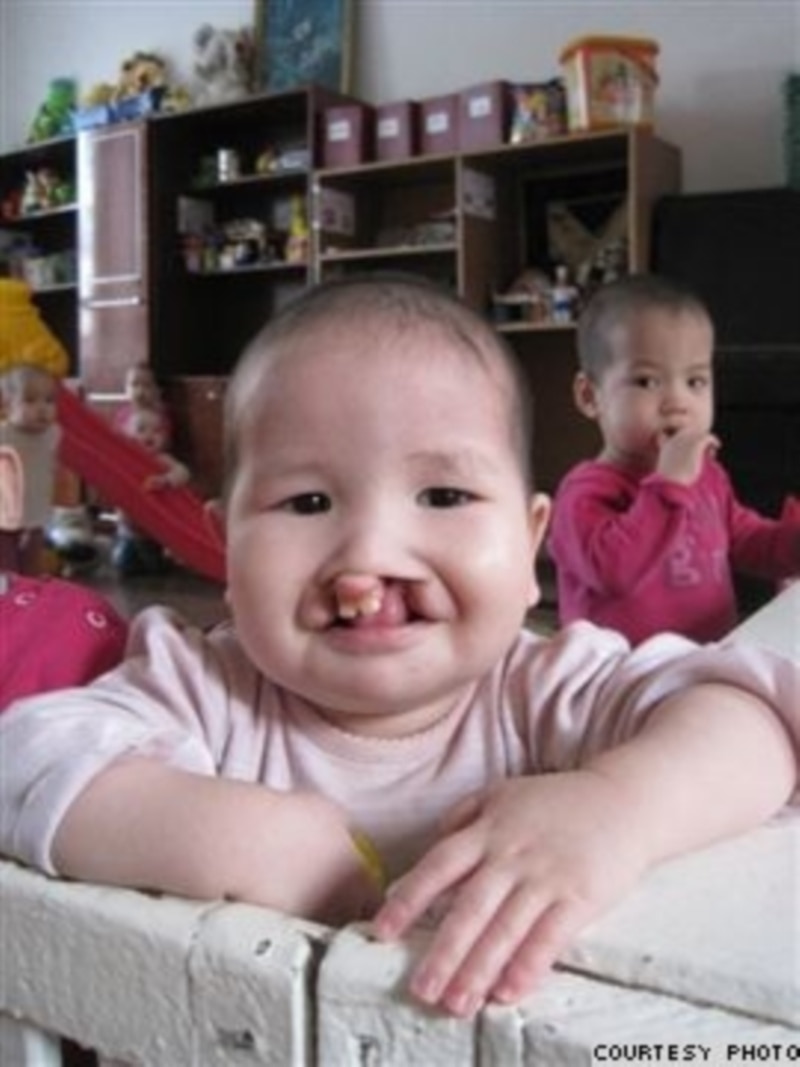 |
| Azamat has suffered from a severe cleft lip and palate since birth. Adoptive parents in Kyrgyzstan almost never choose a disabled or sick child. |
In addition, the lack of supervision was seen as a gateway for adoption agencies, officials, and others to take advantage of the situation by giving children away for adoption without proper background checks on adoptive parents. There were also allegations of corruption on the part of officials who would speed up adoption processes in return for bribes.
Strict Control Of Adoption
Kyrgyz lawmaker Damira Niyazalieva says "we needed to put a specific, state body in charge of international adoption, to control the whole process from the very beginning."
According to the amended version of the Family Code, Kyrgyzstan's Social Welfare Ministry will now oversee all adoption cases. This, Niyazalieva says, ensures strict government control.
"For instance, in the past, random adoption agencies would go inside orphanages to pick a child for adoption,” Niyazalieva says. “They would take photos of children to send to the U.S. It's against the law -- now the law bans such activities. No one from outside will have access to orphanages.”
“There will be a so-called bank with the list of all children available for adoption. Only the Social Welfare Ministry will decide which child can be placed for adoption and to which family."
Niyazalieva and other lawmakers have also proposed that Kyrgyzstan sign the Hague Adoption Convention, which strengthens protection for adoptive children. Ratified by 83 countries, the treaty provides a framework for signatory states to work together to ensure that adoptions take place in the best interests of a child.
The draft of the new Kyrgyz Family Code was reportedly prepared a year ago but the 2010 political upheaval in the country delayed its endorsement.
“Kyrgyz 65”
Kyrgyzstan's decision to lift its adoption moratorium has been eagerly awaited by a group known as "Kyrgyz 65." The group was set up by 65 prospective adoptive families from the United States, who began an adoption procedure in Kyrgyzstan two to three years ago, before the process was halted by Kyrgyz authorities.
Gabrielle Shimkus is among the Kyrgyz 65 who have undergone thorough background checks and provided all the necessary documents, including confirmation of their health and financial situation, which are required of potential adoptive families.
Shimkus says she first visited Azamat in November 2008 when he was a frail five-month-old baby referred for adoption by the Kyrgyz authorities.
After spending two weeks with Azamat in Bishkek, the Shimkus family was told to return to Kyrgyzstan after one month to get the final court decision and take Azamat home as their legally adopted child.
Gabrielle Shimkus says the family was weeks away from bringing home a son, but it didn't happen.
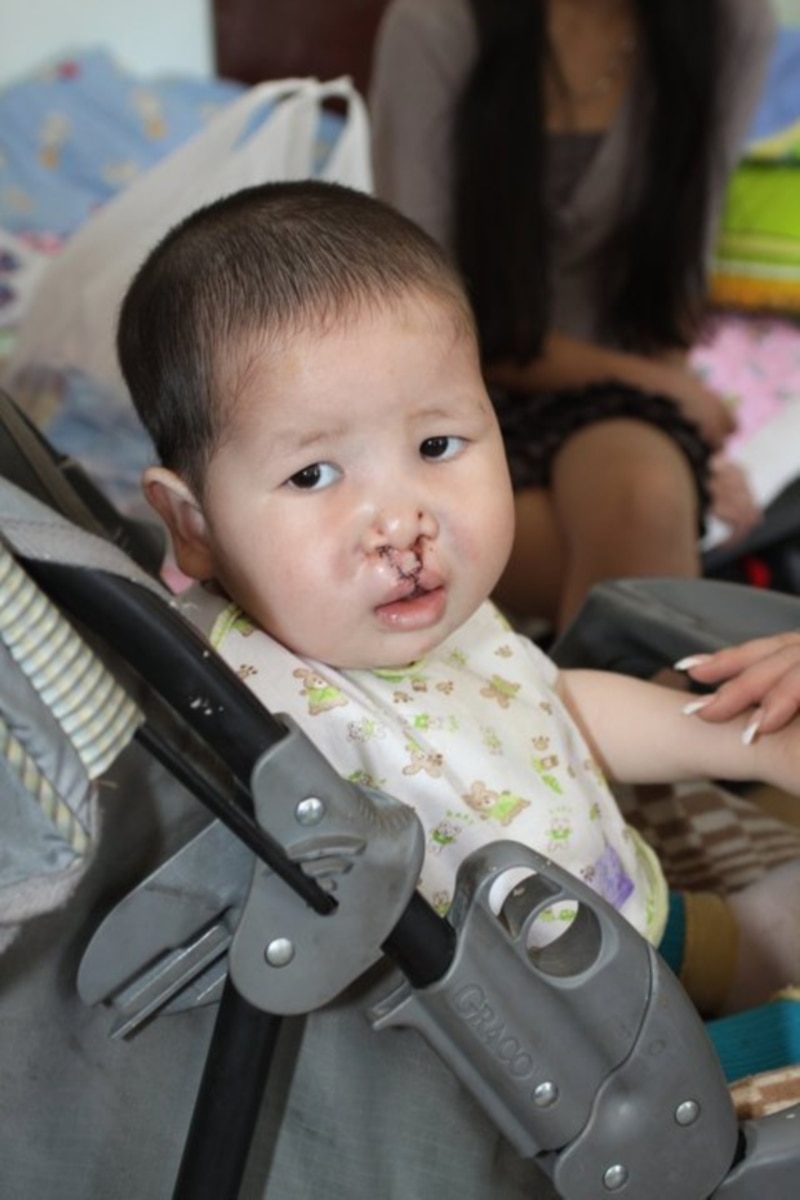 |
| Frank and Gabrielle Shimkus have already paid for surgery on Azamat's lip and palate. They hope to continue his treatment in the U.S. |
Sixty-four other prospective parents were left in a similar situation. They have since involved the U.S. State Department and have contacted a number of U.S. lawmakers in their bid to convince the Kyrgyz authorities to allow adoptions. The group also appealed to Kyrgyz President Otunbaeva.
"We've organized efforts to talk to people in the Kyrgyz government, and we've organized efforts to talk to our own government,” Shimkus says. “And we have conference calls all the time just trying to do everything possible to get our kids home with us.”
“Unfortunately, a lot of the kids have severe medical problems that are treatable and fixable here in the United States. Two of the children of the Kyrgyz 65 passed away and that is such a tragedy in our minds because had the adoptions been able to get through in a timely manner those deaths were preventable."
Some 11,000 orphans and children abandoned by families reside in Kyrgyzstan's 120 orphanages and children's homes. Most of the abandoned babies were born with birth defects or severe disabilities.
"Of the 65 children set to be adopted by American parents, 36 are in urgent need of complicated surgical procedures," the office of Kyrgyz ombudsman told Kyrgyz media. "Their physical conditions are getting worse by every passing day."
Between 2006 and February 2009 -- before the moratorium was put in place -- 235 Kyrgyz children were adopted by families from the United States, Israel, Italy, Germany, and Australia.
The new Family Code gives priority to Kyrgyz families in all adoption cases. But Niyazalieva says adoptive parents in Kyrgyzstan almost never choose a disabled or sick child, while it is not an issue for foreigners, including the Kyrgyz 65.
Cash-Strapped Orphanages
Niyazalieva and the office of the ombudsman are among those who support the idea of reinstating international adoptions, saying it would ensure a much better future for many disabled children who live in underfunded orphanages run by underpaid staff.
Most children's homes in Kyrgyzstan largely depend on cash-strapped state funds and donations by international charity organizations. Conditions are especially dire in state-run orphanages in rural areas, where employees complain about a lack of running water and sewerage systems in children's homes, and a shortage of proper clothes and shoes for kids.
Dr. Gulzhan Ashimova works at a Bishkek care home, which houses 94 sick and disabled children under the age of four.
They need medical attention, including surgeries, speech therapy, and psychological treatments, the doctor says.
"We help them as much as we can, but the orphanage doesn't have enough money for all the treatment we require," Ashimova says. "Some of the required treatments are simply not available in Kyrgyzstan."
Ashimova says that children in orphanages are usually much less developed both physically and psychologically than those who live with families. "The best therapy for them is to live with families," the doctor adds.
While waiting for the Kyrgyz authorities' decision to lift the moratorium, the Shimkus family paid for a German surgeon to begin treatment of Azamat's cleft lip and palate. The doctor visited Bishkek and performed initial medical surgery on Azamat's lip. The toddler needs several more such operations to fully heal his condition.
The family hopes they will be able to continue with the medical treatment in the United States.
"We have already prepared a bedroom full of toys for Azamat in our home, and we all are waiting for our son to finally join us," Gabrielle Shimkus says. "We love him very much. After all, he has been through so many hardships already in his life."
You can find this article at Radio Free Europe.
Adoptive mom, Melanie, has answered these questions many times over the years. She is happy to share her insights into some of the most common adoption-related questions.
Why international vs. domestic adoption? We talked to several families, read a few books, and followed many a blog to learn that birth parents often change their minds after the child’s born. We couldn’t bear the thought of that happening so international adoption seemed like the safer choice for us. While I think every state’s rules vary somewhat on parental rights post placement, my husband and I knew we’d never be able to detach ourselves from a child once that decision had been made.
Why did you select Little Miracles? Outside of being caring, open and knowledgeable and working with an outstanding coordinator, Little Miracles is licensed in our state and works directly with many countries. If the country we’d been adopting from decided to close adoptions to the U.S., we knew that working with an agency that had relationships with multiple countries would ensure we could more easily switch if needed. Their direct in-country relationships were also incredibly important in shortening the length of the adoption process. Many agencies work through other agencies adding as much as a year or two to the timing of an adoption.
Why did you choose Kazakhstan? We explored every country open to the U.S. at the time we were pursuing adoption, and interestingly enough Kazakhstan wasn’t our first choice. But the two places we were interested in were closed or presented years of waiting. After much research, we finally landed on Kazakhstan based on the care of the children, their general health, and the shorter duration (approx. 10 -12 months in 2007 and 2010) of the process from start to finish. My husband and I will be forever grateful to the country of Kazakhstan for the two incredible children it led us to.
Would you adopt from Kazakhstan again? Yes, we adopted from Kazakhstan again last year. It was the easier choice for many reasons, but mainly because it was so familiar. My husband and I both have had a longing to return to the place and the people, and relive our experience all over again. It’s also nice to know that both of our girls share a Kazakh heritage and we can return someday to their birthplace as a family.
What was the most challenging part about adopting from Kazakhstan? The in-country adoption process is longer and a little more unpredictable than some of the other international options. There’s a 14-day bonding period followed by a 1-2 week wait for the court hearing. During our first trip, we lived in Kazakhstan for 32 days for both adoptions. Then there’s a return 5-7 day trip about a month after the first visit. If there’s a delay because the judge decides to take vacation or your trip coincides with a holiday, then you might wait a little longer to finalize the process. Stuff happens and you have to be flexible enough to deal with it.
What was the most challenging part of adopting? The wait. Always the wait. On the front end and then again on the backend as we waited to bring our children home. That part was excruciating. The paperwork was time-consuming, but nowhere near as challenging. Before we actually met our child, fear of the unknown also ranked pretty high up there. We’d traveled across the globe many times, but Kazakhstan was completely unfamiliar to us. Add to that foreigner feeling becoming parents for the first time and the natural fear and raw emotion that comes with it, and you have a challenged pair. Nothing that wasn’t easily overcome and forgotten once our children were home with us. All challenges aside, we’d do it all over again for our girls.
If you have adoption questions please email info@littlemiracles.org. We'd love to talk with you about your adoption plans!
April 8, 2011, Office of Children's Issues - US State Department
On the evening of April 7, 2011, President Yanukovych signed a Decree transferring all functions of, the State
Department for Adoption and Protection of the Rights of the Child (SDA-- the current central adoption authority of Ukraine), to the Ministry for Social Policy. We do not yet know how the implementation of this transfer will affect processing of adoption cases. Whether SDA will be able to continue processing currently filed cases remains unclear.
The Presidential Decree will become effective immediately upon its publication in the Government’s official newspapers, which may be as early as Monday, April 11.
According to SDA, there are now 134 U.S. families registered with the SDA, some of them already in-country. We are asking all American families that are currently in Ukraine or have appointments with SDA during the next few weeks to send their contact information to the U.S. Embassy in Ukraine’s Adoption Unit at: kyivadoptions@state.gov . Families should contact their local adoption service provider for further updates and details.
We will keep monitoring the situation and will provide updates as they become available.
On the evening of April 7, 2011, President Yanukovych signed a Decree transferring all functions of, the State
Department for Adoption and Protection of the Rights of the Child (SDA-- the current central adoption authority of Ukraine), to the Ministry for Social Policy. We do not yet know how the implementation of this transfer will affect processing of adoption cases. Whether SDA will be able to continue processing currently filed cases remains unclear.
The Presidential Decree will become effective immediately upon its publication in the Government’s official newspapers, which may be as early as Monday, April 11.
According to SDA, there are now 134 U.S. families registered with the SDA, some of them already in-country. We are asking all American families that are currently in Ukraine or have appointments with SDA during the next few weeks to send their contact information to the U.S. Embassy in Ukraine’s Adoption Unit at: kyivadoptions@state.gov . Families should contact their local adoption service provider for further updates and details.
We will keep monitoring the situation and will provide updates as they become available.

Four-year-old Kaleb speaks English and likes to draw. He shows talent as a pianist and is learning how to read. He has even visited the Kyrgyzstan Embassy in Washington to meet officials from his native country.
Until he was eight months old, Kaleb was Kalychbek Baymyrzaev, an orphan in Kyrgyzstan. Scott and Kami DeBoer of Dayton, Ohio, adopted him in October 2007, just before Kyrgyzstan placed a moratorium on international adoptions. “Kaleb knows that he is adopted and that he was born in Kyrgyzstan,” Scott told EurasiaNet.org.
The first six months in America were difficult. “When we first met Kaleb, he was only 11 pounds. That is very tiny for an eight-month-old. He was not getting enough to eat. He was not sitting up or rolling. He had a lot of trouble sleeping and had night terrors. We kept reassuring him that we were there and after six months he was sleeping through the night. Later he began to smile,” said Kami.
Scott and Kami are waiting to adopt another Kyrgyz boy, Bakyt. When they met in February 2008, he was two months old; now he is over three. “We did not think it would take very long to bring him home. We will keep waiting for Bakyt,” Scott said. “He is a part of our family.”
In 2008, responding to local rumors that foreigners were adopting babies to harvest their organs, the Kyrgyz government imposed a moratorium on international adoptions. Since then, American families, including the DeBoers, have been waiting to bring home 65 children whose adoptions were in progress when the freeze was announced. According to the Ministry of Social Protection, 30 of the 65 orphans have special health conditions and need regular treatment that is difficult to find in Kyrgyzstan. Two have died. Families in Kyrgyzstan have adopted only four.
Since the collapse of Kurmanbek Bakiyev’s administration last spring, new officials have promised to lift the moratorium and allow the adoptions to proceed. But Minister of Social Protection Aygul Ryskulova, who served as Minister of Labor, Employment and Migration under the old regime, says the government is just too busy to deal with the adoptions. What’s more, concerns linger about the process and the Americans’ motivations. “The facts are still being investigated,” Ryskulova said of the motivations behind the original freeze. “During the last three years the Kyrgyz government found out the whereabouts of most of the children [who had been adopted prior to the ban]. Some of them were adopted by Israeli families, some by Germans, some of them by US parents. But we still don’t know where some children are. We don’t have an exact number of internationally adopted children, where they were sent, how they live now. We have to find out this information.”
The United States has urged the new government to speed the investigation and lift the ban. In February, Ambassador Susan Jacobs, Special Advisor to the Office of Children's Issues in the State Department, traveled to Bishkek to assure local officials that Washington will regularly inform them about the adopted children's lives in the United States until they turn 18, according to local media reports.
MP Shirin Aitmatova, who has pushed for the adoption process to be reformed, says her colleagues in parliament have difficulties understanding the urgency of the issue, given the wide array of social and economic challenges facing Kyrgyzstan.
Moreover, she says, anyone wishing to help with reforms must combat the persistent rumors that foreigners are using the Kyrgyz children for profit. “There was fear that children could potentially be used as organ donors. Some people also assume that since American families that adopt receive certain financial benefits and tax breaks, they must be doing it less out of the goodness of their hearts and rather to supplement their income. Many unfounded ideas circulate in the local population regarding foreigners who express the wish to adopt local children,” Aitmatova explained.
In 2007, Mala Tyler adopted a Kyrgyz boy, Beck, and brought him home to Concord, New Hampshire. She urges Bishkek to lift the moratorium, arguing that the delay only hurts the children. “If the Kyrgyz government has concerns about the welfare of the adopted children, then they need not look any further than the children who are already home. They are loved, they are cherished, they are happy. Relinquishing a child, whether by a parent or by a country, is surely not an easy decision -- certainly not to be taken lightly -- but these children have homes and parents and siblings waiting for them. They have a life full of love waiting for them,” Tyler said.
Yet it seems a knee-jerk fear remains a persistent challenge to any hopes for reform. A parliamentary deputy and former human rights ombudsman, MP Tursunbai Bakir uulu, says that Kyrgyz society is right to be concerned about how these children, often living in underfunded institutions in Kyrgyzstan, will be treated abroad. Without providing evidence, he told EurasiaNet.org: “There are so many stories in the world when adopted children were abused, humiliated, even killed. I don’t support international adoption."
Editor's note:
Beishe Bulan is the pseudonym for a Kyrgyz journalist.
Originally published by EurasiaNet.org
Until he was eight months old, Kaleb was Kalychbek Baymyrzaev, an orphan in Kyrgyzstan. Scott and Kami DeBoer of Dayton, Ohio, adopted him in October 2007, just before Kyrgyzstan placed a moratorium on international adoptions. “Kaleb knows that he is adopted and that he was born in Kyrgyzstan,” Scott told EurasiaNet.org.
The first six months in America were difficult. “When we first met Kaleb, he was only 11 pounds. That is very tiny for an eight-month-old. He was not getting enough to eat. He was not sitting up or rolling. He had a lot of trouble sleeping and had night terrors. We kept reassuring him that we were there and after six months he was sleeping through the night. Later he began to smile,” said Kami.
Scott and Kami are waiting to adopt another Kyrgyz boy, Bakyt. When they met in February 2008, he was two months old; now he is over three. “We did not think it would take very long to bring him home. We will keep waiting for Bakyt,” Scott said. “He is a part of our family.”
In 2008, responding to local rumors that foreigners were adopting babies to harvest their organs, the Kyrgyz government imposed a moratorium on international adoptions. Since then, American families, including the DeBoers, have been waiting to bring home 65 children whose adoptions were in progress when the freeze was announced. According to the Ministry of Social Protection, 30 of the 65 orphans have special health conditions and need regular treatment that is difficult to find in Kyrgyzstan. Two have died. Families in Kyrgyzstan have adopted only four.
Since the collapse of Kurmanbek Bakiyev’s administration last spring, new officials have promised to lift the moratorium and allow the adoptions to proceed. But Minister of Social Protection Aygul Ryskulova, who served as Minister of Labor, Employment and Migration under the old regime, says the government is just too busy to deal with the adoptions. What’s more, concerns linger about the process and the Americans’ motivations. “The facts are still being investigated,” Ryskulova said of the motivations behind the original freeze. “During the last three years the Kyrgyz government found out the whereabouts of most of the children [who had been adopted prior to the ban]. Some of them were adopted by Israeli families, some by Germans, some of them by US parents. But we still don’t know where some children are. We don’t have an exact number of internationally adopted children, where they were sent, how they live now. We have to find out this information.”
The United States has urged the new government to speed the investigation and lift the ban. In February, Ambassador Susan Jacobs, Special Advisor to the Office of Children's Issues in the State Department, traveled to Bishkek to assure local officials that Washington will regularly inform them about the adopted children's lives in the United States until they turn 18, according to local media reports.
MP Shirin Aitmatova, who has pushed for the adoption process to be reformed, says her colleagues in parliament have difficulties understanding the urgency of the issue, given the wide array of social and economic challenges facing Kyrgyzstan.
Moreover, she says, anyone wishing to help with reforms must combat the persistent rumors that foreigners are using the Kyrgyz children for profit. “There was fear that children could potentially be used as organ donors. Some people also assume that since American families that adopt receive certain financial benefits and tax breaks, they must be doing it less out of the goodness of their hearts and rather to supplement their income. Many unfounded ideas circulate in the local population regarding foreigners who express the wish to adopt local children,” Aitmatova explained.
In 2007, Mala Tyler adopted a Kyrgyz boy, Beck, and brought him home to Concord, New Hampshire. She urges Bishkek to lift the moratorium, arguing that the delay only hurts the children. “If the Kyrgyz government has concerns about the welfare of the adopted children, then they need not look any further than the children who are already home. They are loved, they are cherished, they are happy. Relinquishing a child, whether by a parent or by a country, is surely not an easy decision -- certainly not to be taken lightly -- but these children have homes and parents and siblings waiting for them. They have a life full of love waiting for them,” Tyler said.
Yet it seems a knee-jerk fear remains a persistent challenge to any hopes for reform. A parliamentary deputy and former human rights ombudsman, MP Tursunbai Bakir uulu, says that Kyrgyz society is right to be concerned about how these children, often living in underfunded institutions in Kyrgyzstan, will be treated abroad. Without providing evidence, he told EurasiaNet.org: “There are so many stories in the world when adopted children were abused, humiliated, even killed. I don’t support international adoption."
Editor's note:
Beishe Bulan is the pseudonym for a Kyrgyz journalist.
Originally published by EurasiaNet.org
Adoption Announcement: Teleconference Invitation
March 24, 2011
TO: Prospective Adoptive Parents, Adoption Service Providers, and Adoption Stakeholders
FROM: U.S. Department of State, Office of Children’s Issues
U.S. Department of Homeland Security,USCIS
SUBJECT: Teleconference on Guatemala Adoptions
Thursday March 31, 2011 @ 10:00 am – 11:00 am (EDT)
March 24, 2011
TO: Prospective Adoptive Parents, Adoption Service Providers, and Adoption Stakeholders
FROM: U.S. Department of State, Office of Children’s Issues
U.S. Department of Homeland Security,USCIS
SUBJECT: Teleconference on Guatemala Adoptions
Thursday March 31, 2011 @ 10:00 am – 11:00 am (EDT)
The U.S. Department of State Office of Children’s Issues Adoptions Division would like to invite prospective adoptive parents, adoption service providers, and adoption stakeholders with an interest in Guatemala adoptions to a teleconference with the Office of Children’s issues and the Department of Homeland Security, U.S. Citizenship and Immigration Services (USCIS) to discuss the status of intercountry adoption processing in Guatemala. The focus of the call will be primarily to provide an updated outlook for resolution of the remaining “grandfathered” adoption cases involving U.S. citizens. This update will include information from a recent trip to Guatemala during which USCIS and the Office of Children’s Issues met with Guatemalan government officials for updates on the status of “grandfathered” adoption cases still pending in Guatemala.
Please join us for this call to learn more about adoption processing in Guatemala.
To join the call –
If you are calling from within the United States, please dial: 1-888-363-4749
If you are calling from outside the United States, please dial: 1-215-446-3662
The passcode for all callers is: 6276702
Please join us for this call to learn more about adoption processing in Guatemala.
To join the call –
If you are calling from within the United States, please dial: 1-888-363-4749
If you are calling from outside the United States, please dial: 1-215-446-3662
The passcode for all callers is: 6276702
Ethiopia Adoption Alert
Adoption Alert
U.S. DEPARTMENT OF STATE
Bureau of Consular Affairs
Office of Children’s Issues
__________________________________
Government of Ethiopia Plans Major Slow-Down in Adoption Processing
March 9, 2011
Citing the need to work on quality and focus on more important strategic issues, the Government of Ethiopia’s Ministry of Women, Children, and Youth Affairs (MOWCYA) will reduce to a maximum of five the number of adoption cases it processes per day, effective March 10, 2011. Under Ethiopian adoption procedures, MOWCYA approves every match between prospective adoptive parents and an Ethiopian child before that case can be forwarded for a court hearing. The U.S. Embassy is working with Ethiopian government officials and adoption agencies to learn more about this change in procedures. We will continue to share information as it becomes available.
Given MOWCYA's current caseload, the U.S. Embassy anticipates that this change could result in an overall decline in case processing of some 90 percent. If this change is implemented as proposed, we expect, that parents who have begun the process of adopting from Ethiopia but have not yet been matched with a child could experience significant delays. It is not clear if this change in procedures would have any significant impact on cases in which MOWCYA has already approved matches.
Prospective adoptive parents should remain in close contact with their adoption service provider to obtain updates on individual cases.
The Embassy's Adoptions Unit can be reached at consadoptionaddis@state.gov.
Adoption Alert
U.S. DEPARTMENT OF STATE
Bureau of Consular Affairs
Office of Children’s Issues
__________________________________
Government of Ethiopia Plans Major Slow-Down in Adoption Processing
March 9, 2011
Citing the need to work on quality and focus on more important strategic issues, the Government of Ethiopia’s Ministry of Women, Children, and Youth Affairs (MOWCYA) will reduce to a maximum of five the number of adoption cases it processes per day, effective March 10, 2011. Under Ethiopian adoption procedures, MOWCYA approves every match between prospective adoptive parents and an Ethiopian child before that case can be forwarded for a court hearing. The U.S. Embassy is working with Ethiopian government officials and adoption agencies to learn more about this change in procedures. We will continue to share information as it becomes available.
Given MOWCYA's current caseload, the U.S. Embassy anticipates that this change could result in an overall decline in case processing of some 90 percent. If this change is implemented as proposed, we expect, that parents who have begun the process of adopting from Ethiopia but have not yet been matched with a child could experience significant delays. It is not clear if this change in procedures would have any significant impact on cases in which MOWCYA has already approved matches.
Prospective adoptive parents should remain in close contact with their adoption service provider to obtain updates on individual cases.
The Embassy's Adoptions Unit can be reached at consadoptionaddis@state.gov.
Two adoptions have delivered two very different experiences. Although both resulted in something wonderful, there’s no doubt one experience greatly influenced the other. Despite being pragmatic through and through, I dove into our adoptions with an open heart. I believe that openness got me through my first day in Aktobe and home with our oldest daughter 3 years ago.
I dreamt about it and thought about it constantly, wondering what those magical moments would be like meeting my child for the first time. Then it happened and it wasn’t anything like I’d expected, even after reading about others’ experiences and being coached on all the plausible scenarios. Looking back, I don’t think anyone could have prepared me for that day or moment, really.
A few years later, and I can recall every precious moment of that first encounter with incredible fondness. But the first 24 hours afterward, I was hardly focused on the good stuff. I was devastated by what I couldn’t control and what wasn’t going to be based on the ill-conceived picture I’d painted in my head. Even then, I realized I should have known better because many things in life don’t go as planned.
Rewind to July 2007. Two near-missed flights, a couple of intense pat downs and 36 hours behind on sleep, we hit the proverbial ground running until we finally arrived in Aktobe, Kazakhstan. It seems like we slept for only an hour before we were on our way to the baby house to meet our daughter. The whole experience was surreal from the dusty, bumpy ride there to the eerie pre-Soviet-era building that housed our child. All this was hardly as intimidating as the raw emotions we encountered on the front steps of the door from a couple who had just learned that the child they'd met the day before was being adopted by another family. Because they hadn’t agreed to adopt the baby the day they'd met her, she was open to other families. They offered a warning about what we could expect inside, but I didn’t need it. The pain in their expressions scared me more.
Finally inside, we listened unintelligently as our team spoke in a ping pong of rapid Russian. Already a little disoriented by the language barrier, I remember the place smelling of heavy paint fumes and several very intense women walking by us with stern expressions and odd looking hats. Then there was a parade of at least ten babies for the Chinese couple in search of a son with long fingers – a sign of intelligence we were told. I think my excitement peeked here as I watched each of these beautiful little bundles cross my path. I assumed our experience would be much the same. I was wrong.
We quickly filed into a dark 8x8 ft. room, no bigger than my cubicle at work, with our coordinator, two translators, a nurse and a doctor. I remember feeling like an animal on display at the zoo. All eyes were on me and my reaction. I was nervous and my adrenaline was on overdrive. In comes a nanny with the first child. They place her tininess in my arms and I melt a little, until they tell me she's 16 months (9 months older than she looks) and suffers from infantile syphilis. Our coordinator, likely noting my sadness, tells our translator to say, "this child is not for you." With that, the nanny removes her from my arms and carries her out of the room. It all happens so fast that I barely manage the two words - she's beautiful - in the mix.
Still slightly in shock after meeting the first child, the second child enters the room. We never even had a chance to hold her. She was easily two years old, scared out of her mind, and rocking back and forth so violently in her caregiver’s arms that I thought she might fall to the ground. Like the first child, she also has an incurable illness; one I can no longer recall. Again, our coordinator announces "this child is not for you" and with that she’s gone. But the visual of her hadn't left me yet. It was probably at this point in the process (emotions and sleeplessness running high) that I wanted to call it off. Mentally, I was drained and didn’t think I could put on a strong front any longer. Our request for a child under 12 months with mild medical conditions we could support at home didn’t seem to be here. And this experience in no way matched up with the one I'd imagined, making everything more difficult to process.
All bad news for the next child we met. Toddling into the room, no sooner did we glance her way than she hid behind her nanny’s pant leg and cried. A couple minutes later she let me pick her up and quickly buried her head in my shoulder. She was terrified of my husband, but curious too. She'd peek, cry and hide. I don't think either one of us got to see her face for more than a few seconds at a time. In the midst of the baby's sobs, the doctor told us about her health, which was better than the previous children we'd seen. Assuming we'd see more children because her age range of 16 months fell outside of our paperwork, we didn't ask a lot of questions. No sooner did I mentally dismiss her than our translator said, "this child is for you." I think it was intended to be a question, but it sounded more like a statement. Not knowing how to politely ask if more children were on their way, the door closed and we were left alone to discuss our interest in this child - the last child we would meet. Our conversation was probably one of the most heartfelt and tearful we'd ever had. I wanted to run, but fortunately my husband wasn't ready to give up. Our team quickly reappeared sensing our anxiety and, stunned, my husband agreed that we would begin the bonding process with the baby the next day. We left the baby house in a state of shock and I cried more than I've ever cried in my life, trying to decide if I was willing to miss out on the baby time I so desperately wanted and bring home a toddler instead. Still undecided, I agreed to spend time bonding with the child the next day.
Thank God because within seconds of seeing our daughter walk into the room, I was absolutely in love. It’s hard for me to admit, even to myself, that I had this type of reaction. And I’ll never tell our daughter this. But what I do know from my experience is that sometimes a day makes a difference.
Here's what I would have missed out on had I said no that day. A kind-hearted, eternally happy, polite little girl with a passion for learning new things and an inquisitiveness that has helped her test out of her grade level on more than one occasion. She's a beautiful dancer, incredible soccer player and an aspiring little artist. Almost five, she dreams of growing up to become an ice-skating princess with magical powers. And I believe she’ll do it. And although the experience of meeting our younger child played out nothing like the first - we saw healthier infants and I knew my child the instant I saw her - we probably would have missed out on this child altogether because we wouldn't have pursued the adoption in the first place. To think my children wouldn't be mine had I never had this experience makes every part of it worthwhile.
I dreamt about it and thought about it constantly, wondering what those magical moments would be like meeting my child for the first time. Then it happened and it wasn’t anything like I’d expected, even after reading about others’ experiences and being coached on all the plausible scenarios. Looking back, I don’t think anyone could have prepared me for that day or moment, really.
A few years later, and I can recall every precious moment of that first encounter with incredible fondness. But the first 24 hours afterward, I was hardly focused on the good stuff. I was devastated by what I couldn’t control and what wasn’t going to be based on the ill-conceived picture I’d painted in my head. Even then, I realized I should have known better because many things in life don’t go as planned.
Rewind to July 2007. Two near-missed flights, a couple of intense pat downs and 36 hours behind on sleep, we hit the proverbial ground running until we finally arrived in Aktobe, Kazakhstan. It seems like we slept for only an hour before we were on our way to the baby house to meet our daughter. The whole experience was surreal from the dusty, bumpy ride there to the eerie pre-Soviet-era building that housed our child. All this was hardly as intimidating as the raw emotions we encountered on the front steps of the door from a couple who had just learned that the child they'd met the day before was being adopted by another family. Because they hadn’t agreed to adopt the baby the day they'd met her, she was open to other families. They offered a warning about what we could expect inside, but I didn’t need it. The pain in their expressions scared me more.
Finally inside, we listened unintelligently as our team spoke in a ping pong of rapid Russian. Already a little disoriented by the language barrier, I remember the place smelling of heavy paint fumes and several very intense women walking by us with stern expressions and odd looking hats. Then there was a parade of at least ten babies for the Chinese couple in search of a son with long fingers – a sign of intelligence we were told. I think my excitement peeked here as I watched each of these beautiful little bundles cross my path. I assumed our experience would be much the same. I was wrong.
We quickly filed into a dark 8x8 ft. room, no bigger than my cubicle at work, with our coordinator, two translators, a nurse and a doctor. I remember feeling like an animal on display at the zoo. All eyes were on me and my reaction. I was nervous and my adrenaline was on overdrive. In comes a nanny with the first child. They place her tininess in my arms and I melt a little, until they tell me she's 16 months (9 months older than she looks) and suffers from infantile syphilis. Our coordinator, likely noting my sadness, tells our translator to say, "this child is not for you." With that, the nanny removes her from my arms and carries her out of the room. It all happens so fast that I barely manage the two words - she's beautiful - in the mix.
Still slightly in shock after meeting the first child, the second child enters the room. We never even had a chance to hold her. She was easily two years old, scared out of her mind, and rocking back and forth so violently in her caregiver’s arms that I thought she might fall to the ground. Like the first child, she also has an incurable illness; one I can no longer recall. Again, our coordinator announces "this child is not for you" and with that she’s gone. But the visual of her hadn't left me yet. It was probably at this point in the process (emotions and sleeplessness running high) that I wanted to call it off. Mentally, I was drained and didn’t think I could put on a strong front any longer. Our request for a child under 12 months with mild medical conditions we could support at home didn’t seem to be here. And this experience in no way matched up with the one I'd imagined, making everything more difficult to process.
All bad news for the next child we met. Toddling into the room, no sooner did we glance her way than she hid behind her nanny’s pant leg and cried. A couple minutes later she let me pick her up and quickly buried her head in my shoulder. She was terrified of my husband, but curious too. She'd peek, cry and hide. I don't think either one of us got to see her face for more than a few seconds at a time. In the midst of the baby's sobs, the doctor told us about her health, which was better than the previous children we'd seen. Assuming we'd see more children because her age range of 16 months fell outside of our paperwork, we didn't ask a lot of questions. No sooner did I mentally dismiss her than our translator said, "this child is for you." I think it was intended to be a question, but it sounded more like a statement. Not knowing how to politely ask if more children were on their way, the door closed and we were left alone to discuss our interest in this child - the last child we would meet. Our conversation was probably one of the most heartfelt and tearful we'd ever had. I wanted to run, but fortunately my husband wasn't ready to give up. Our team quickly reappeared sensing our anxiety and, stunned, my husband agreed that we would begin the bonding process with the baby the next day. We left the baby house in a state of shock and I cried more than I've ever cried in my life, trying to decide if I was willing to miss out on the baby time I so desperately wanted and bring home a toddler instead. Still undecided, I agreed to spend time bonding with the child the next day.
Thank God because within seconds of seeing our daughter walk into the room, I was absolutely in love. It’s hard for me to admit, even to myself, that I had this type of reaction. And I’ll never tell our daughter this. But what I do know from my experience is that sometimes a day makes a difference.
Here's what I would have missed out on had I said no that day. A kind-hearted, eternally happy, polite little girl with a passion for learning new things and an inquisitiveness that has helped her test out of her grade level on more than one occasion. She's a beautiful dancer, incredible soccer player and an aspiring little artist. Almost five, she dreams of growing up to become an ice-skating princess with magical powers. And I believe she’ll do it. And although the experience of meeting our younger child played out nothing like the first - we saw healthier infants and I knew my child the instant I saw her - we probably would have missed out on this child altogether because we wouldn't have pursued the adoption in the first place. To think my children wouldn't be mine had I never had this experience makes every part of it worthwhile.
--Melanie Hill
Subscribe to:
Posts (Atom)
